 Lillory
Sign in
Lillory
Sign in
How to teach consonant digraphs, step by step.
A digraph is two letters that make one sound the letters do not make on their own: the sh in ship, the ch in chip, the th in thin. Digraphs come right after single-letter sounds are secure, and they are the first time a reader has to stop reading letter by letter and read a pair as one. Here is how to teach them so that switch sticks.
Name the idea before the first word: two letters, one sound.
A reader who has just learned that every letter makes a sound will try to read ship as s, h, i, p. So start with the idea, not a word. Show the pair, say the one sound it makes, and say plainly that these two letters have teamed up to make a new sound together. A reader who knows to expect that will look for the pair instead of being tripped by it.
Teach one digraph to the point of ease before adding the next.
Start with sh, because its sound is easy to hold and hard to confuse. Read a whole set of sh words, then dictate a few for spelling, before ch arrives. Then th, which has two sounds, the quiet one in thin and the voiced one in this; let a reader feel the difference with a hand on the throat. Our free decodable word lists keep sh, ch and th on separate lists so nothing outside the pattern you are teaching sneaks in.
Practice reading and spelling in the same session.
Reading a digraph and spelling it are two different skills, and the second is what proves the first. After a reader can read a set of sh words, dictate three or four and watch what they write. A child who reads ship but spells it sip has not learned the digraph yet; they have memorised a few words. Spelling is where the pair becomes a rule.
Add the ck and the doubling that travel with digraphs.
At this stage a reader also meets ck for the /k/ sound at the end of a short word (duck, rock), and the doubled ff, ll and ss that end words like puff, bell and miss. Teach these as their own small rules: ck and the doubles come right after a single short vowel. They fit here because they share the closed-syllable ground the digraphs sit on. Where all of this lands in the wider order is on our scope and sequence.
Watch for the two slips.
The first slip is reading the pair as two sounds, s, h instead of sh. The second is the reverse in spelling, writing one letter for the pair. A quick daily check of five words, read and then spelled, tells you which slip is happening and whether the digraph is set or still needs a day.
See it in the app
Digraphs, as a level.
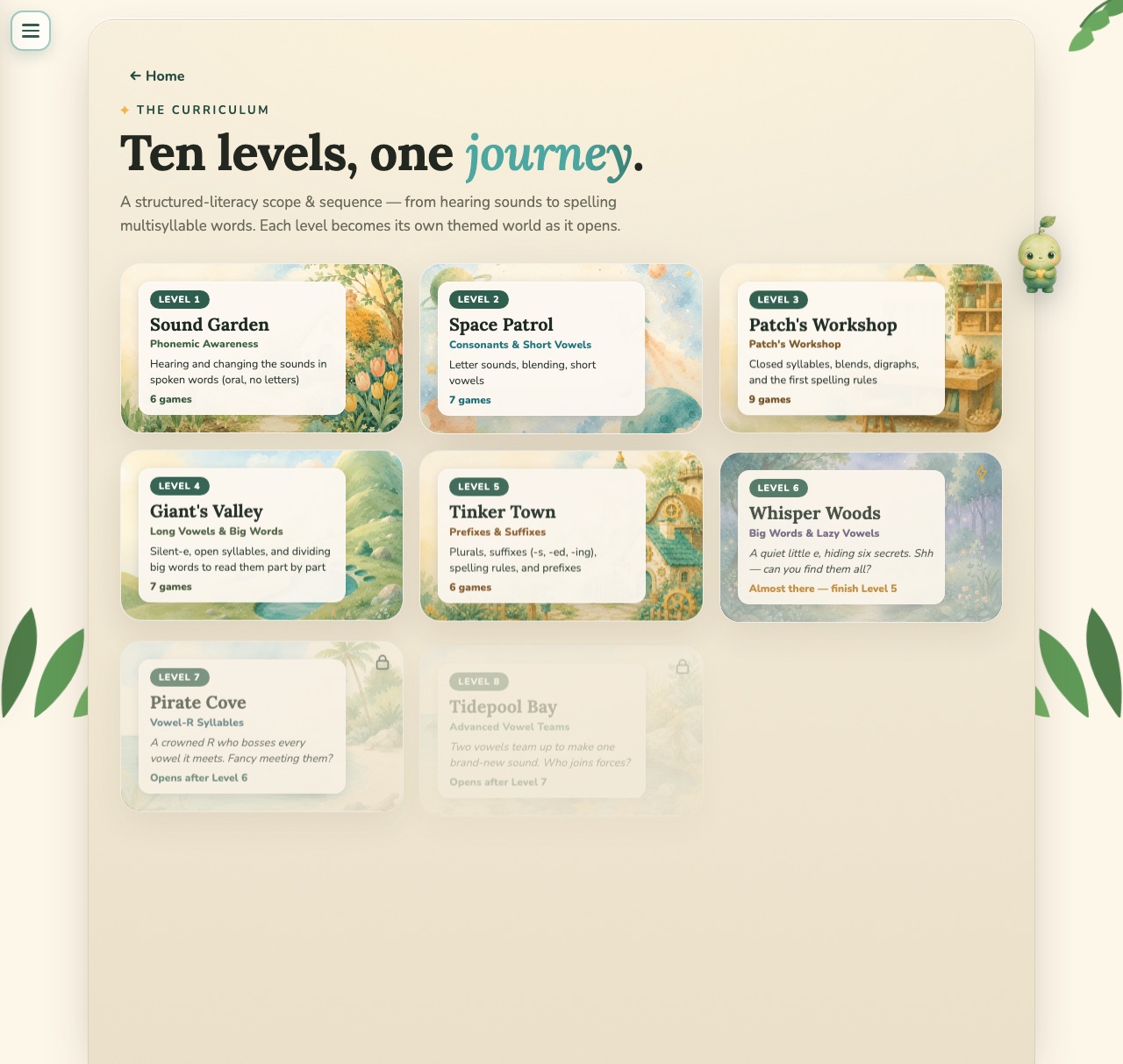
In Lillory, digraphs live in Patch's Workshop (Level 3), the closed-syllable workshop where sh, ch and th arrive along with the ck and doubling rules. A reader reaches it in order, once the short-vowel levels are secure.
Level 3: Sort It, Rule Breakers, and the Patch's Workshop games.
Open Lillory