 Lillory
Sign in
Lillory
Sign in
Structured literacy, explained.
Structured literacy is a way of teaching reading that is explicit, systematic and cumulative: every skill is taught directly, in a deliberate order, and checked before the next one is added. It is the approach most reading science points to for children who do not pick reading up on their own, and it is what a good dyslexia tutor uses. Here is what it means in plain terms, how it differs from the way many children are taught, and why it works.
Explicit: nothing is left to be guessed.
In structured literacy, a child is told directly how the code works. The letter m makes the /m/ sound; here is how your mouth makes it; here is a word that starts with it. Nothing important is left for the child to infer from context or pictures. For a struggling reader, that difference is everything, because the thing they cannot do is work the rule out on their own.
Systematic and cumulative: a deliberate order, each step checked.
Skills are taught in a sequence that goes from simple to complex, and each one rests on the last. Single sounds before blends, short vowels before long, one syllable before two. A reader does not meet a vowel team until the short vowels are secure. That order is not arbitrary; it is a scope and sequence, and following one is how a teacher knows what to teach next and where a reader got stuck.
The pieces it teaches.
Structured literacy covers the sounds of speech and how to hear them in words (phonemic awareness), the links between sounds and the letters that spell them (phonics and decoding), the syllable types and spelling rules, the meaningful word parts like prefixes and roots, and the fluency, vocabulary and comprehension that reading is ultimately for. The early, decoding pieces are where a struggling reader most often needs the explicit, step-by-step teaching, and where an app can carry a lot of the repetition.
How it differs from balanced or whole-language teaching.
Many children are taught to read by being surrounded by books and encouraged to use context, pictures and the first letter to guess at words. Strong readers often manage this way. Struggling readers usually do not, because guessing is exactly the habit that hides the gap. Structured literacy replaces the guess with a reliable way to sound a word out. If your child guesses at words instead of sounding them out, that is the difference in one sentence.
Why it works for struggling readers.
A child who learns the code explicitly can read words they have never seen, because they are decoding rather than remembering. Practice then turns those decoded words into fast, automatic reading. It is slower at the start than memorising a handful of words, and it pays off because it does not run out: the same method that reads cat reads catastrophe a few years later. For what it looks like day to day, see how Lillory teaches.
See it in the app
Structured literacy, as a path.
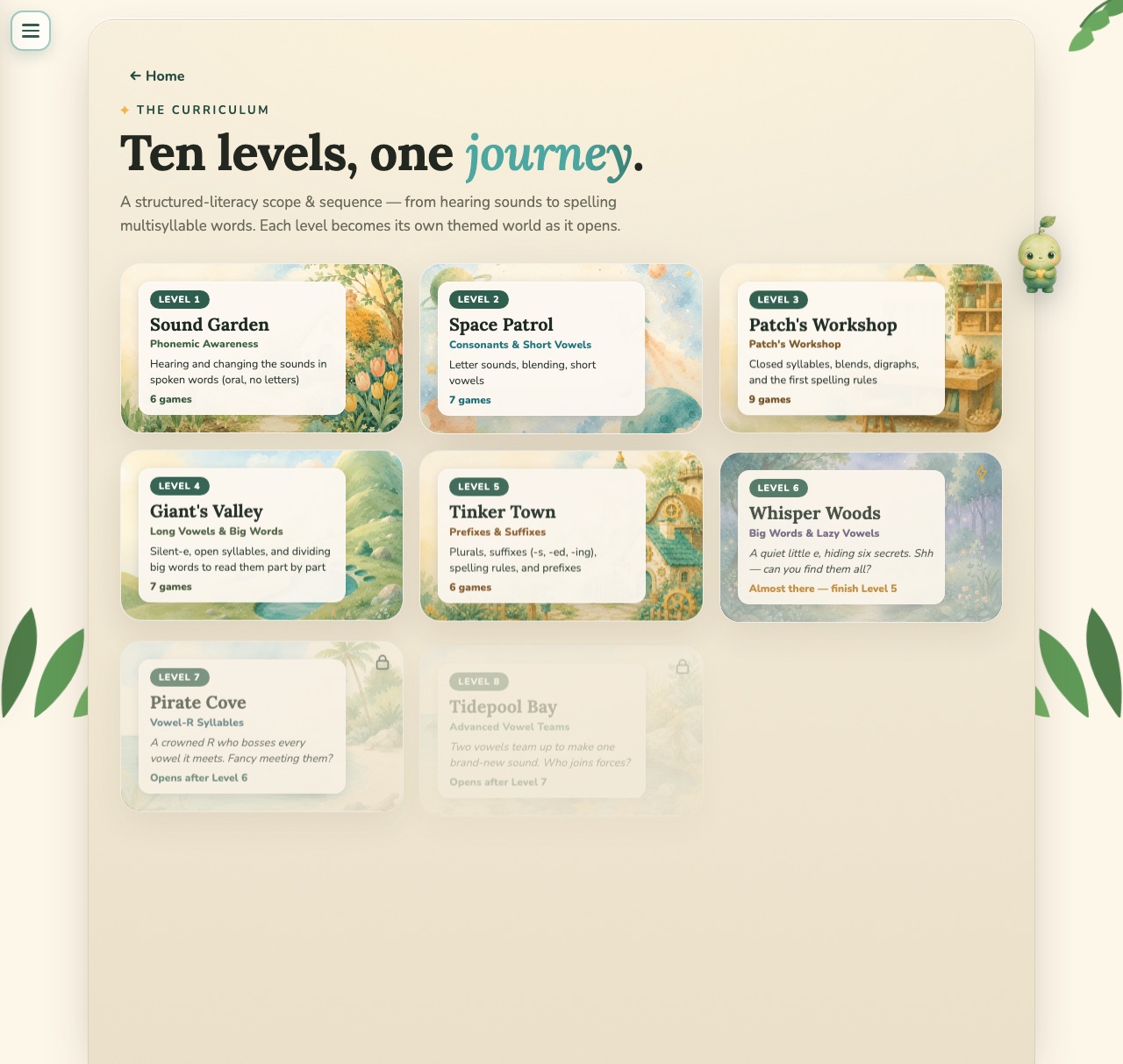
Lillory lays the whole method out as a map: sounds, then letters, then patterns, then longer words, each level resting on the one before. A reader moves through it in order, and the same order tells a tutor exactly where they are.
Shown: the ordered levels, from the first sounds to multisyllable words.
Open LilloryQuestions people ask.
What is structured literacy in simple terms?
It is teaching reading explicitly and in a set order, so every skill is taught directly and checked before the next is added. Sounds come before letters, short vowels before long, one syllable before two.
Is structured literacy the same as phonics?
Phonics, the link between sounds and spellings, is a central part of structured literacy, but not all of it. Structured literacy also teaches hearing sounds in words, syllable types, spelling rules, word parts, and fluency and comprehension, all in a planned sequence.
Is structured literacy good for children with dyslexia?
It is the approach most often recommended for readers who struggle, including those with dyslexia, because it does not rely on a child working the code out for themselves. A professional evaluation guides the specifics for any individual child.
Read next: Signs a child is struggling with reading