 Lillory
Sign in
Lillory
Sign in
Sound-spelling chart.
English writes one sound many ways: the long a in cake, rain and play is the same sound with three spellings. This free chart lists, for each sound, the common ways to spell it, with an example word for every one. Use it to plan what to teach next, to answer a reader who asks why a word looks the way it does, or to print a reference for the table. Pick a group, then copy or print the part you need.
Short vowels one sound, one spelling
The first vowels a reader meets. Each has a single common spelling, which is what makes short-vowel words the place to start.
- short a: a as in cat
- short e: e as in bed
- short i: i as in pig
- short o: o as in dog
- short u: u as in bug
Long vowels the vowel says its name
Each long vowel has several spellings. Teach one at a time, and keep a chart like this in view so a reader can see they are all the same sound.
- long a: a_e as in cake
- long a: ai as in rain
- long a: ay as in play
- long a: eigh as in eight
- long e: ee as in feet
- long e: ea as in leaf
- long e: e as in me
- long e: y as in happy
- long e: ie as in chief
- long i: i_e as in bike
- long i: igh as in light
- long i: y as in my
- long i: ie as in pie
- long o: o_e as in home
- long o: oa as in boat
- long o: ow as in snow
- long o: o as in go
- long u: u_e as in cube
- long u: ue as in blue
- long u: ew as in few
R-controlled and other vowels the vowels that bend
When r follows a vowel it takes charge of the sound. The last few rows are the slides and hooks that do not fit long or short.
- ar as in car
- or as in fork
- er as in her
- ir as in bird
- ur as in turn
- oi as in coin
- oy as in boy
- ou as in cloud
- ow as in cow
- aw as in saw
- au as in haul
- oo (long) as in moon
- oo (short) as in book
Tricky consonants one sound, more than one letter
Most consonants spell one sound one way. These are the ones that do not, and they cause a large share of early reading slips.
- the /k/ sound: c as in cat
- the /k/ sound: k as in kite
- the /k/ sound: ck as in duck
- the /s/ sound: s as in sun
- the /s/ sound: c as in city
- the /j/ sound: j as in jam
- the /j/ sound: g as in gem
- the /j/ sound: dge as in bridge
- the /f/ sound: f as in fan
- the /f/ sound: ph as in phone
- the /z/ sound: z as in zip
- the /z/ sound: s as in dogs
Consonant digraphs two letters, one new sound
A digraph is two letters that make one sound the letters do not make alone. These arrive right after single-letter sounds are secure.
- sh as in ship
- ch as in chip
- tch as in catch
- th (quiet) as in thin
- th (voiced) as in this
- wh as in when
- ng as in ring
- ck as in duck
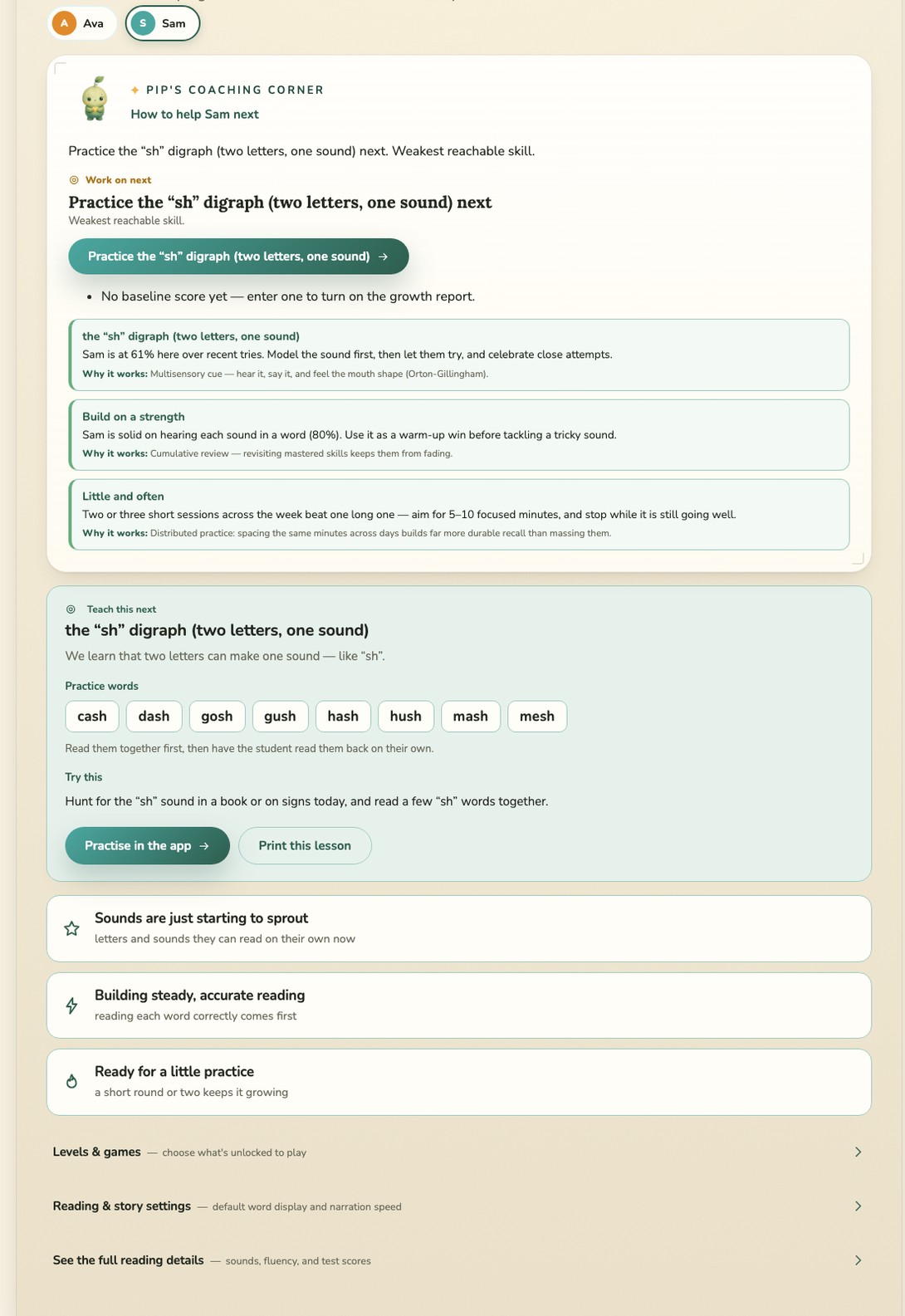
See it in the app
The chart, turned into practice.
In Lillory a reader meets these spellings in order, one sound at a time, with a game for each. The tutor dashboard shows which spelling comes next for a child and hands you the words to practice it.
Shown: the next skill to teach and its ready-made practice words.
Open LilloryHow to use a sound-spelling chart.
Teach one spelling of a sound to the point of ease before you add the next. When you introduce the second spelling of a sound, put it next to the first so the reader sees they say the same thing: rain and cake share a sound, not a spelling. For a reader who spells by guessing, the chart answers the question behind the guess, which is not what letter but which of the ways to write this sound. The order these spellings are taught in is on our free scope and sequence, and the practice words for each are on our decodable word lists.
Questions practitioners ask.
What is the difference between a phoneme and a grapheme?
A phoneme is a sound; a grapheme is a letter or group of letters that spells it. The word ship has three sounds and three graphemes: sh, i, p. A sound-spelling chart lines up each sound with the graphemes that can spell it.
In what order should I teach the spellings of a sound?
Teach the most common, most reliable spelling first, secure it, then add the next. Long a usually starts with a_e, then ai and ay. The full order is on our scope and sequence.
Is this chart tied to a specific program?
No. Which letters spell which sounds is public fact, part of Orton-Gillingham aligned structured literacy. This chart is our own selection of the common correspondences and is not copied from any commercial program.
Take the chart with you
Copy any group above, or save the whole chart. Free, and no sign-up.
Read next: Word mapping: connecting sounds to spellings
Built by people who teach this every day.
See how Lillory helps tutorsFree during the pilot · new seats reviewed a few at a time