 Lillory
Sign in
Lillory
Sign in
How to read a reading progress report without being fooled.
Every reading product will hand you a chart that goes up. Before you let one reassure you about your child or your student, ask it three questions. Most charts cannot survive all three.
Question one: which words made this number?
If a child drills a list of words all week and is then scored on the same list, the chart measures memory, and memory is not reading. A number worth trusting comes from words the child had never seen before that moment. If the report cannot tell you which words were tested, that silence is the answer.
Question two: when were they tested?
One good afternoon proves very little. A skill that is real shows up again days later, on different words, without a warm-up. Look for evidence spread across separate days. A single-session score, however high, is a mood, not a measurement.
Question three: how sure is sure?
A chart that says 100% after three questions is not lying, exactly. It is just not saying anything. Small samples swing wildly. An honest report tells you how much evidence sits behind each claim, and says openly when it does not know yet. Confidence without evidence counts is decoration.
What passing all three looks like.
It looks slower. Fewer skills marked as mastered, more marked as still growing, and the occasional honest we do not know yet. That restraint is the feature. A report that flatters you is working for the product. A report that survives these three questions is working for the child. We wrote ours to survive them, and published exactly how it works so you can check.
What that looks like in a report.
Here is a sample, built from an example reader. Read across each row: the words behind the number, the days they were spread over, and the confidence with the evidence count behind it. Notice how much of it says still growing or not enough evidence yet. That restraint is what makes the rest worth trusting.
Example progress report
A sample reader, Grade 2
In Lillory, a skill counts as mastered only after at least 10 brand-new words, 95% confidence, across 3 separate days. Everything else is shown honestly as still growing, or not enough evidence yet.
See it in the app
Where a report like this comes from.
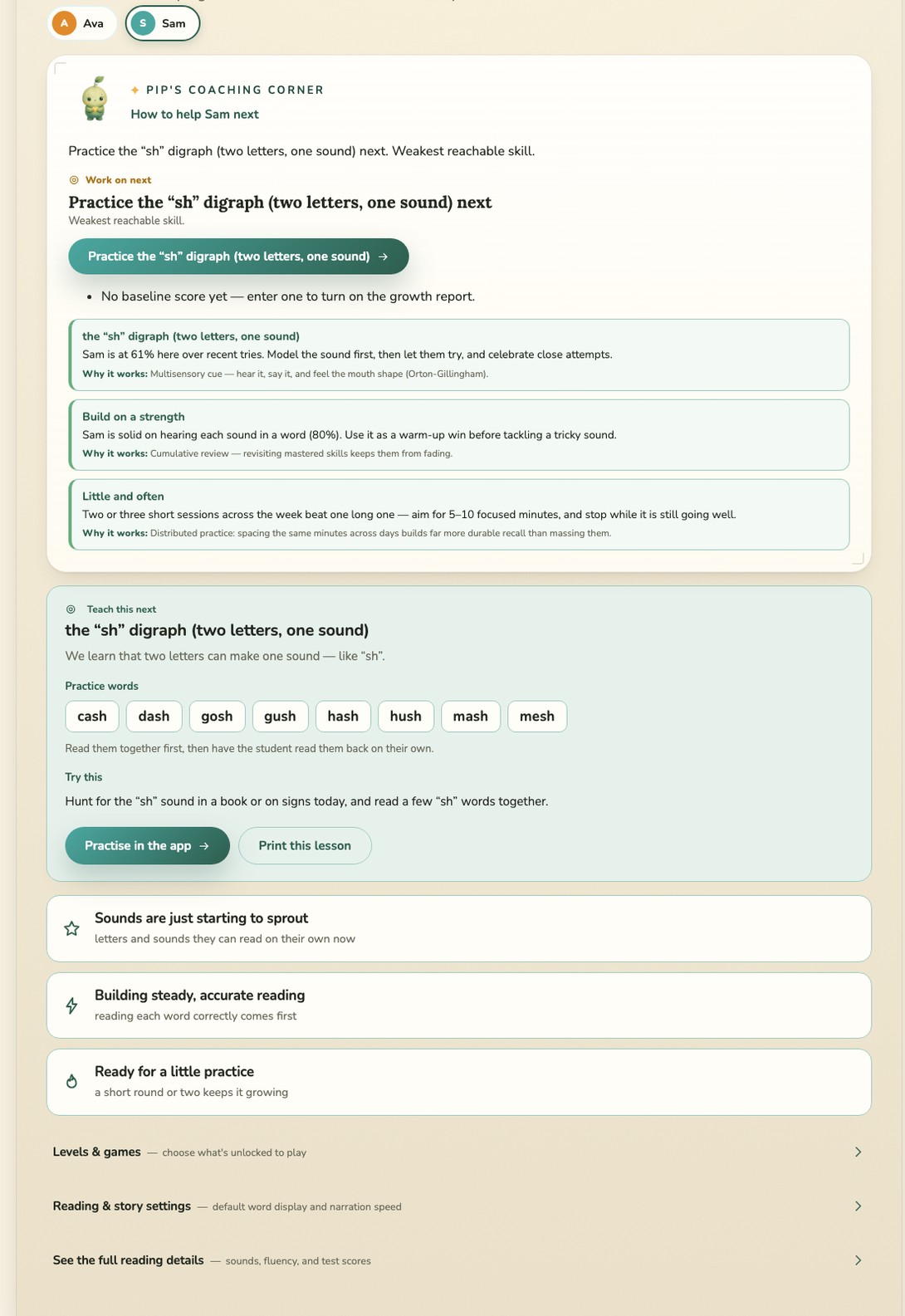
This is the tutor's view in Lillory: each skill with the evidence behind it, the next skill worth teaching, and decodable words ready to practice. The sample above is what a family reads, and this is what stands behind it.
Shown: per-skill status, the next reachable skill, and ready-made practice words.
Open Lillory