 Lillory
Sign in
Lillory
Sign in
The structured literacy scope and sequence.
A structured literacy scope and sequence teaches decoding in a fixed order, so every new word a reader meets only uses skills already taught. The shared order moves from the sounds of spoken words, to short vowels and consonants, through the six syllable types (closed, open, silent-e, vowel team, r-controlled, and consonant-le), and out to the prefixes, suffixes and roots that unlock long words. The order is not a matter of taste: a reader cannot decode a vowel team before a short vowel. Below is that sequence, stage by stage, with the public sources that place each one.
The six syllable types, first.
Most of the sequence is organised around a public Orton-Gillingham construct: every English syllable is one of six types, and knowing the type tells a reader what the vowel is doing. The six are the closed syllable, the open syllable, the vowel-consonant-e (silent-e) syllable, the vowel team, the r-controlled syllable, and the consonant-le syllable (Reading Rockets, The Six Syllable Types). The stages below teach them in the order a reader can actually build on.
-
1. Phonemic awareness
Hearing, blending, segmenting and changing the individual sounds in spoken words, before any letters are attached. This is oral work: it is what letters are later mapped onto.
Placed first by Reading Rockets and Keys to Literacy, because a child maps letters onto sounds they can already hear.
-
2. Consonants, short vowels, and reading CVC words
The single letter sounds, then blending them into short-vowel words like cat, bed and pig. This is the closed syllable in its simplest form, and the first real reading a child does.
Grounded in Common Core Reading: Foundational Skills (RF.K.3), UFLI Foundations, and Reading Rockets.
-
3. Closed syllables: blends, digraphs, and the first spelling rules
Consonant blends (stop, fast), digraphs (ship, chin, thick), and the earliest orthographic rules: doubling f, l, s after a short vowel, choosing c or k, and the ck and tch spellings.
Sequenced here by UFLI Foundations, Keys to Literacy, and the closed syllable type.
-
4. Silent-e (the vowel-consonant-e syllable)
The pattern that makes a vowel say its name: cap becomes cape, hop becomes hope. It is the third of the six syllable types and the first long-vowel pattern a reader can rely on.
A named syllable type, taught at this point across the Virginia TTAC phonics sequence checklist.
-
5. Long vowels, vowel teams, open syllables, and dividing longer words
Vowel teams (rain, boat, see), the open syllable (a vowel at the end of a syllable says its name, as in me and go), and the syllable-division strategies that let a reader break a two-syllable word apart to read it.
Placed after the short-vowel code by Common Core (RF.2.3), UFLI Foundations, and Reading Rockets.
-
6. R-controlled vowels
The vowels that change when an r follows them: ar (car), or (fork), and the er, ir, ur that mostly share one sound (her, bird, turn). Frequent, consistent spellings are usually taught before the rarer ones.
The fifth syllable type, sequenced here by UFLI Foundations and Keys to Literacy.
-
7. The consonant-le syllable and the schwa
The final chunk in words like table, candle and little, and the lazy unstressed vowel (the schwa) that appears in almost every longer word. Both are needed to read multisyllable words fluently.
The sixth syllable type, placed among the multisyllable skills by Keys to Literacy.
-
8. Prefixes, suffixes, and roots (morphology)
The meaningful parts of long words: first the endings -s, -ed and -ing and the spelling rules that attach them, then common prefixes and suffixes, and finally Latin and Greek roots. Morphology rides on top of a secure code, so it comes last and keeps going for years.
Sequenced across grades by Common Core (RF.1.3, L.4.4, L.5.4), the Virginia TTAC checklist, and Keys to Literacy.
A note on order, honestly.
No two programs number their lessons identically, and the exact point where morphology or the vowel teams enter varies. What does not vary are the dependencies: a reader has to hear sounds before mapping letters, read short vowels before long ones, and read single words before peeling their prefixes. This sequence reflects that shared structure, not any one program. Lillory is built on Orton-Gillingham aligned structured literacy principles and follows this same progression.
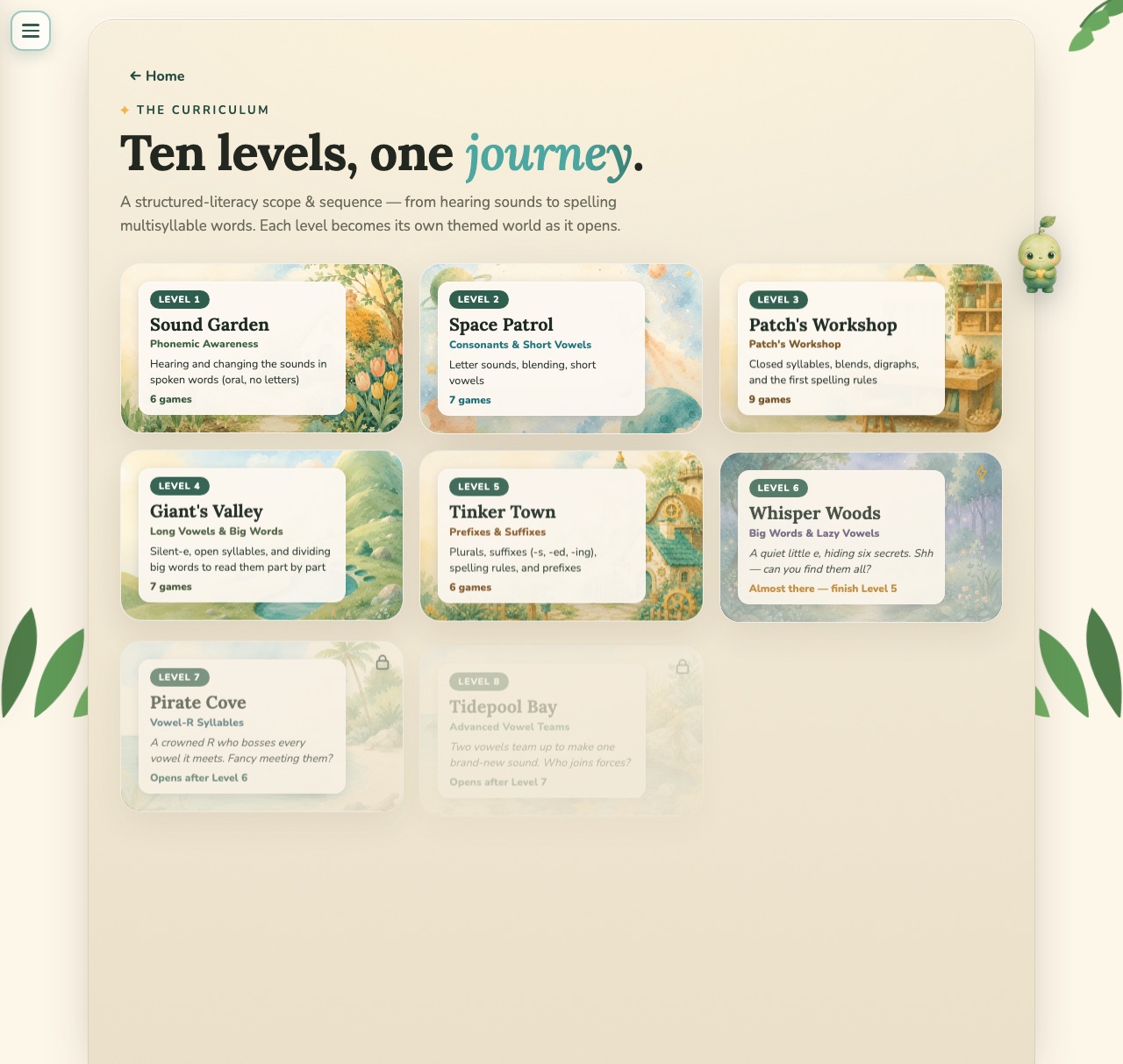
See it in the app
The same sequence, built for a child.
Every stage on this page is a world in Lillory, from Sound Garden (hearing the sounds) up through the vowel and word-building levels. A child plays the skills in order, and a tutor sees exactly where they are.
In the app: ten levels, from hearing sounds to multisyllable words.
Open LilloryQuestions practitioners ask.
What is a structured literacy scope and sequence?
It is the fixed order in which decoding skills are taught, arranged so each new skill only relies on skills already taught. It runs from phonemic awareness, through the six syllable types, to the prefixes, suffixes and roots of long words.
What are the six syllable types?
Closed, open, vowel-consonant-e (silent-e), vowel team, r-controlled, and consonant-le. Every English syllable is one of the six, and the type tells a reader what the vowel is doing.
Is this the same as an Orton-Gillingham scope and sequence?
The six syllable types and this ordering are public Orton-Gillingham aligned structured literacy constructs, reproduced across the sources cited above. This reference is not tied to, endorsed by, or copied from any commercial program.
Keep the sequence
Save it as a one-page reference. Free, and no sign-up.
Built on this sequence, for the tutors who teach it.
See how Lillory helps tutorsFree during the pilot · new seats reviewed a few at a time