 Lillory
Sign in
Lillory
Sign in
The six syllable types, explained.
English looks irregular until you can see its syllables. Almost every word breaks into syllables of six types, and each type tells the reader what its vowel will do. Learn the six, and a long word stops being a wall of letters and becomes a short run of readable chunks. Here is each type, with examples and the order most structured literacy programs teach them.
1. Closed syllable
One vowel followed by at least one consonant, and the vowel says its short sound: cat, hand, split. It is taught first because every later type is measured against it. How to teach a closed syllable.
2. Open syllable
Ends in a single vowel with no consonant after it, so the vowel says its long name: me, go, hi, and the first syllable of pa-per. How to teach open syllables.
3. Silent-e syllable (vowel-consonant-e)
A vowel, one consonant, then a silent e that makes the vowel long: cake, bike, hope. How to teach silent-e.
4. Vowel team syllable
Two letters work together to spell one vowel sound: rain, boat, seed, day. How to teach vowel teams.
5. R-controlled syllable
A vowel followed by r, which changes the vowel into a new sound: car, bird, corn. How to teach r-controlled vowels.
6. Consonant-le syllable
A final chunk of a consonant, l and a silent e, read as one beat: ta-ble, lit-tle, ap-ple. How to teach the consonant-le syllable.
Why the six types matter
A vowel letter can say several sounds, and the syllable type is what tells a reader which one to try. Once a child can name the type in front of them, a long word is no longer a guess. They break it into syllables, read each type by its rule, and push the parts back together. The same six types also explain spelling, because the type decides how the vowel is written.
The order to teach them
Closed comes first, then silent-e and open, then vowel teams and r-controlled, with consonant-le last because it only appears inside longer words. One type is secure before the next begins, and syllable division is taught once a reader has two types to divide between. The full sequence, with the sounds and spellings under each stage, is on our structured literacy scope and sequence, and the words to practice each stage are on our free decodable word lists.
Common questions
What are the six syllable types?
Closed, open, silent-e, vowel team, r-controlled, and consonant-le. Each one signals what its vowel will do.
Which type is taught first?
The closed syllable, because it holds the short-vowel sound every later pattern is compared against.
Why teach syllable types at all?
They turn a long, unfamiliar word into a short series of chunks a reader can decode by rule instead of by guessing.
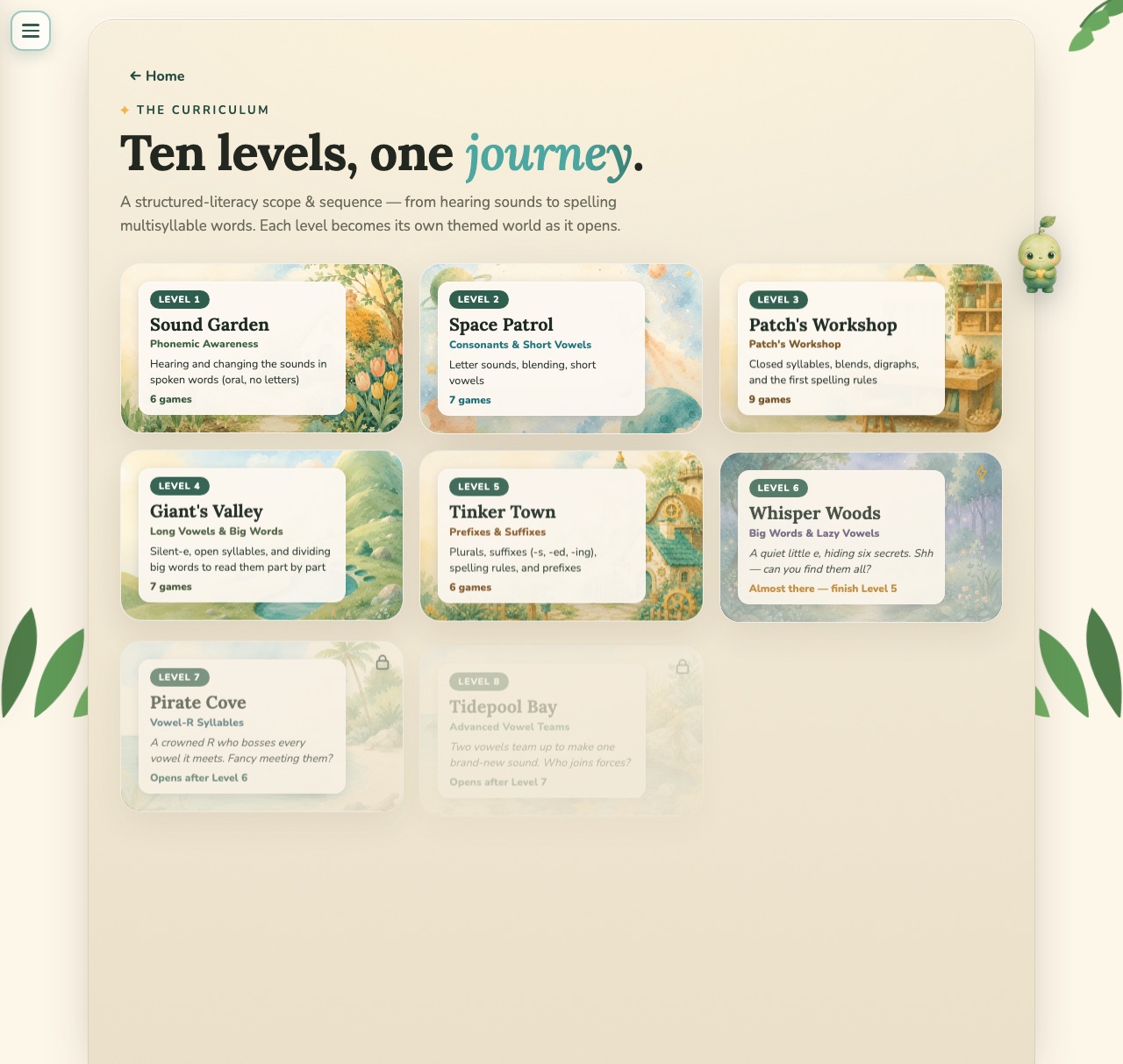
See it in Lillory: the syllable games sit in the middle levels, after a reader is steady on single sounds. How Lillory teaches, stage by stage.
See it in the app
The syllable types, level by level.
In Lillory, the six syllable types are taught across the level map, each in its own stage of games, from short vowels up through vowel teams and the consonant-le ending. A child moves through them in order, the same order as this guide.
Levels 2 to 8: a stage of games for each syllable type.
See how Lillory teaches