 Lillory
Sign in
Lillory
Sign in
What your child's dyslexia test scores mean.
A dyslexia or reading evaluation ends in a stack of numbers, and most parents are handed them with little more than "follow up with a reading specialist." This is a plain guide to what those numbers mean, how to turn a low score into something you can actually practice, and how to tell, months later, whether the practice is working. Lillory does not evaluate or diagnose; a qualified professional does that. What this guide does is help you read the report and act on it.
A score is a starting line, not a verdict.
Each number in a report describes where a child is today on one narrow skill, compared with other children their age. It points at what to work on next. It is not a measure of how smart a child is, and it is not a ceiling. The value of an evaluation is not the label at the end; it is the map in the middle, the profile of which reading skills are strong and which are behind, because that map is what tells you exactly what to practice.
What the common tests actually measure.
A reading evaluation breaks reading into the parts it is built from and checks each one. You will usually see some mix of these, named by their initials:
- Sound awareness
How well a child hears and moves the individual sounds inside spoken words: blending them, pulling them apart, swapping them. This is the foundation decoding rests on. (Often checked by the CTOPP-2.)
- Naming speed
How quickly a child can name a page of familiar letters, colors or objects. Slow naming often travels with reading difficulty. (Also part of the CTOPP-2, sometimes called rapid naming or RAN.)
- Reading single words
How accurately and how quickly a child reads real words and made-up "nonsense" words. Nonsense words matter because they show whether a child is decoding the letters or recognizing a memorized shape. (TOWRE-2, and the word-identification part of the WIST.)
- Reading passages
How smoothly and accurately a child reads connected text aloud, and how much they understand of it. (DIBELS-8, GORT-5.)
- Spelling
How a child spells, which is a clear window into how solidly they have mapped sounds to letters. Spelling errors are often more revealing than reading errors. (The spelling part of the WIST.)
What the numbers mean, in plain terms.
Most reports use two kinds of numbers. Once you can read them, the report stops being a wall of jargon.
- Standard scores
Built so that 100 is exactly average. Roughly 85 to 115 is the average range. A score below about 85 is below average; well below that points to a real gap worth acting on. Most subtests report this way.
- Percentiles
The percent of same-age children a child scored above. The 50th percentile is right in the middle. The 16th percentile means 84 out of 100 peers scored higher, a signal the skill needs direct work.
- Age and grade equivalents
Rough by design ("reads like a mid-first-grader"). Useful for a plain-language feel, but do not lean on them; standard scores and percentiles are steadier.
Read the profile, not one number. The classic pattern behind reading difficulty is a low sound-awareness or word-reading score sitting next to average or strong reasoning: the child is bright, and decoding is the specific thing that is hard. That contrast is exactly what a plan should target.
From score to plan: the bridge nobody draws.
This is the step reports skip. Take the one or two areas the report flagged and match each to what to practice, in order, one skill at a time rather than all at once:
- Low sound awareness
Practice hearing and moving sounds first: blending sounds into words and segmenting words back into sounds, out loud, before and alongside the letters. See the structured literacy scope and sequence for the order, and sound and letter games for how it looks in practice.
- Slow or inaccurate word reading
Build accuracy first, then speed, on one spelling pattern at a time, using words a child can actually decode. Our free decodable word lists are grouped by pattern, and how to use a decodable word list walks through a session.
- Weak spelling
Map each sound in a word to the letters that spell it, so the word is stored, not guessed. Word mapping is the technique; the sound-spelling chart is the reference.
- Reads the words but does not understand
When decoding takes all of a child's effort, little is left for meaning. Make decoding effortless on the current pattern first; comprehension usually follows. See reads the words but does not understand.
If that feels like a lot to sequence, that is what a structured-literacy tutor, or a tool built on the same sequence, does for you: it places the child by skill and serves the next one in order.
How to tell it is working: measure the same thing again.
A plan is only as good as your ability to see whether it is moving. The trick is to re-check the same skill the report flagged, the same way, over time.
Growth on decoding looks like this, in order: more words read accurately on the pattern being taught, then the same words read faster, then fewer sounds missed on new words of that pattern.
Re-take the standardized tests rarely, usually every 6 to 12 months and through the school or evaluator. Track the specific skill you are practicing far more often, weekly, so you catch movement between the big tests.
Be wary of a chart that only shows time spent and lessons finished. That measures effort, not reading. Ask what was measured and when. Our guides how Lillory measures a reader's practice, how to read a progress report, and how to tell if a reading app is working go deeper.
See it in the app
Match the plan to the gap, then watch that gap.
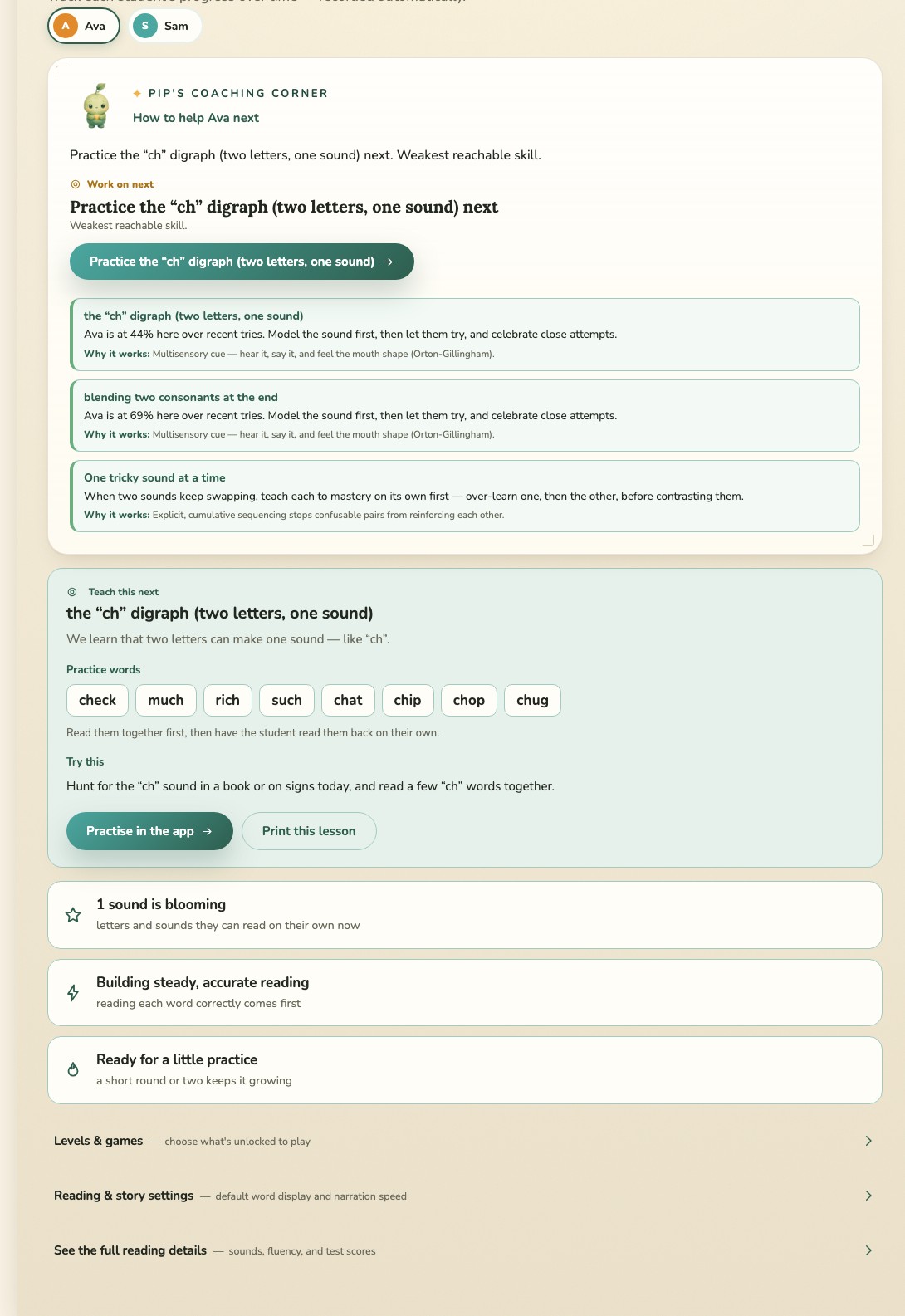
Lillory places a reader by skill, practices the next one in the structured-literacy order, and keeps an automatic record of accuracy on each pattern over time. It is not an evaluation and it does not diagnose. It is the week-to-week view of the exact skill an evaluation flagged, so you can see whether it is moving.
Open LilloryQuestions parents ask.
What is a good score on a dyslexia test?
On standard scores, roughly 85 to 115 is the average range, with 100 as the middle; on percentiles, the 50th is average. But no single number tells the story. A child can score in the average range overall and still have one specific skill, often sound awareness or word reading, sitting well below the rest. The profile matters more than any one figure.
My child scored low on one test but average on another. What does that mean?
That split is common and genuinely useful: it shows where the specific gap is. A low sound-awareness or word-reading score next to stronger reasoning is the pattern most associated with reading difficulty, and it tells you what to practice first.
Can I turn the scores into a practice plan myself?
In outline, yes: match each low area to the matching skill, and practice it in order rather than all at once. Sound awareness before letters, accuracy before speed, one spelling pattern at a time. A structured-literacy tutor or a tool built on the same sequence does the ordering for you.
How often should my child be re-tested?
The standardized tests, usually every 6 to 12 months and through the school or evaluator. The specific skill you are working on at home, weekly, so you can see it move between the larger tests instead of waiting a year to find out.
Does a low score mean my child has dyslexia?
Not on its own. A diagnosis is made by a qualified professional who weighs the whole profile, the child's history, and other factors together. This guide is educational information, not a diagnosis. What you can do without waiting is start good, targeted practice on the skills the report flagged.